
Gold Casting in Jewelry: From Molten Metal to a Piece with a Story
Gold casting is one of the most important stages of jewelry-making in our workshop. It is the moment when a design — previously existing as a sketch, technical drawing, 3D model, or wax form — begins to take real shape in precious metal. For the client, the finished jewelry is often, above all, a ring, wedding band, pendant, or pair of earrings. For us, it is the result of many precise decisions: choosing the alloy, preparing the model, making the mold, controlling temperature, metal shrinkage, and later processing and finishing.
At the Ka:ma jewelry workshop, gold casting is not merely a technical procedure. It is the moment when design meets material. Even the most beautiful concept must be properly translated into metal so that the jewelry is not only striking, but also durable, comfortable, and refined in every detail.
What exactly is gold casting?
Gold casting involves melting a properly prepared gold alloy and pouring it into a mold that reproduces the shape of the future piece of jewelry. Once the metal solidifies, the mold is removed, and the casting moves on to further jewelry work.
It sounds simple, but in practice it is a process that requires extensive knowledge and experience. Gold must be at the right temperature, the mold must be properly prepared, the casting channels must allow the metal to freely fill every detail, and the design itself must be adapted to practical production requirements.
In our workshop, casting allows us to achieve forms that would be difficult to create using only traditional manual methods. We use this technique for rings, wedding bands, pendants, signet rings, earrings, openwork elements, decorative details, and personalized projects. This does not mean, however, that casting is the end of the work. At Ka:ma, the casting is only the beginning of a long process of refining the jewelry.
Why is gold not cast as pure gold?
Pure gold, meaning 999 gold, is very rarely used in jewelry. It is too soft for everyday wear. That is why jewelry-making uses gold alloys, which combine gold with other metals that give it the right hardness, color, and practical properties.
The most common gold finenesses are:
585, or 14-karat gold, containing 58.5% pure gold. It is popular because of its good durability and resistance to everyday use.
750, or 18-karat gold, containing 75% pure gold. It is more precious, has a deeper color, and is often chosen for premium jewelry.
The color of gold depends on the composition of the alloy. Yellow gold owes its classic shade to the right proportions of additional metals, rose gold gets its warm tone from a higher copper content, and white gold is created by using metals that lighten and cool the color of the alloy.
At the Ka:ma jewelry workshop, the choice of alloy is never accidental. A delicate engagement ring with a large stone requires a different approach than a massive signet ring, and a wedding band worn every day for many years requires another. Color, hardness, durability, polishing method, the possibility of later renovation, and the character of the entire design all matter.
From design to model: before the gold reaches the crucible
The casting process in our workshop begins much earlier than the moment the metal is melted. First, the jewelry design is created. At Ka:ma, we most often begin with hand sketches, conversations with the client, mood boards, inspirations, and initial concepts. Only then is the design technically refined.
At this stage, we anticipate how the form will behave in metal. Jewelry that looks beautiful in a sketch must still meet structural requirements. We analyze thicknesses, proportions, areas exposed to wear, the method of stone setting, comfort of wear, and the possibility of later finishing.
Once the concept is ready, we prepare the model. It may be made by hand in wax or digitally, based on a 3D design. In our workshop, we often combine these methods: the design begins by hand, is then refined in 3D software, and later printed in castable resin or milled in wax.
The model is the pattern for the future jewelry. It is what will be reproduced in the casting mold. That is why it must be precise, clean, and carefully considered. Every detail, proportion, and imperfection may later be reflected in the metal.
The wax model and the lost-wax method
One of the most important techniques we use at the Ka:ma jewelry workshop is the lost-wax method. Its history goes back thousands of years, yet it remains one of the fundamental methods of making jewelry today.
The process involves creating a model from wax or a material that can be burned out of the mold. The model is then placed in a special investment material. After the material hardens, the entire piece goes into a kiln. The high temperature burns out the wax or resin, leaving an empty space inside in the shape of the future jewelry. Molten metal will later be poured into this space.
The name “lost-wax method” comes from the fact that the model is destroyed during burnout. Each casting therefore requires a separate model, unless a mold has previously been prepared for reproducing wax models.
In our workshop, this method allows us to combine artistic freedom with great precision. We can create subtle details, organic lines, openwork forms, and complex structures that would be very difficult to achieve using only hand forging or soldering.
3D printing and modern model preparation
At the Ka:ma jewelry workshop, we also use 3D technology. We do not treat it as a departure from craftsmanship, but as an extension of design possibilities. After the digital design is approved, the model can be printed from a material intended for casting.
3D printing allows us to precisely control proportions, symmetry, stone placement, and repeatable elements. It is especially useful for technically complex projects, wedding bands with ornaments, signet rings, rings with multiple stones, or jewelry with unusual geometry.
However, printing alone does not guarantee quality. The model must be checked, cleaned, and assessed for casting. We make sure that all elements have the appropriate thickness, that the metal will be able to flow properly through the mold, and that later finishing will not destroy delicate details.
At Ka:ma, 3D technology is a tool, not a substitute for experience. The final decisions still belong to the designer and jeweler, who understand the behavior of metal.
Casting channels: the invisible part of a good casting
One of the key stages of casting preparation is planning the casting channels. These are special passages through which molten gold flows into the mold. Although they are not visible in the finished jewelry, they have a huge impact on the quality of the casting.
The channels must be arranged so that the metal can fill the entire mold evenly and without interruptions. It is necessary to predict how the gold will flow, where it may solidify too quickly, and where bubbles, shrinkage cavities, or incomplete castings may appear.
For simple forms, the channel layout may be relatively straightforward. For complex designs — for example rings with an openwork crown, delicate details, or multi-level structures — it requires a great deal of practice. A mistake at this stage may make the casting unsuitable for further work.
In our workshop, a good casting begins with invisible technical decisions.
Preparing the casting mold
Once the model and channels are ready, we place the whole structure in a casting cylinder and pour in a special investment material. The investment must fully surround the model, enter every detail, and create a stable mold resistant to high temperatures.
At this stage, removing air bubbles is very important. If air becomes trapped near the surface of the model, it can later create defects in the casting. That is why the mold is deaerated or prepared under conditions that help achieve the cleanest possible reproduction.
After the investment sets, the cylinder goes into the kiln. The wax or resin is burned out, and the mold is heated. The temperature and heating time depend on the model material, the size of the casting, and the type of investment. This is very important, because an improperly burned-out model may leave impurities that affect the quality of the metal surface.
The mold must be clean, stable, and properly heated at the moment of casting.
Melting gold: temperature, purity, and control
The next stage is preparing the gold. The metal goes into a crucible, where it is heated to its melting point. We control both the temperature and the purity of the material. If the temperature is too low, the gold may not fill the mold. If it is too high, the quality of the alloy may deteriorate, increasing the risk of oxidation, porosity, or material loss.
With gold, it is not only melting itself that matters, but also preserving the properties of the alloy. The additional metals present in the alloy may behave differently than pure gold. This is why working with different colors and finenesses of gold requires experience.
At Ka:ma, we ensure that the metal is properly prepared, clean, and suited to the project. If we use gold entrusted to us by the client, for example from family jewelry, we first assess its condition, fineness, and potential for reuse. Not every old alloy is suitable for direct use in a new casting — sometimes it requires cleaning, supplementing, or melting together with new material to achieve the proper quality.
The casting moment itself
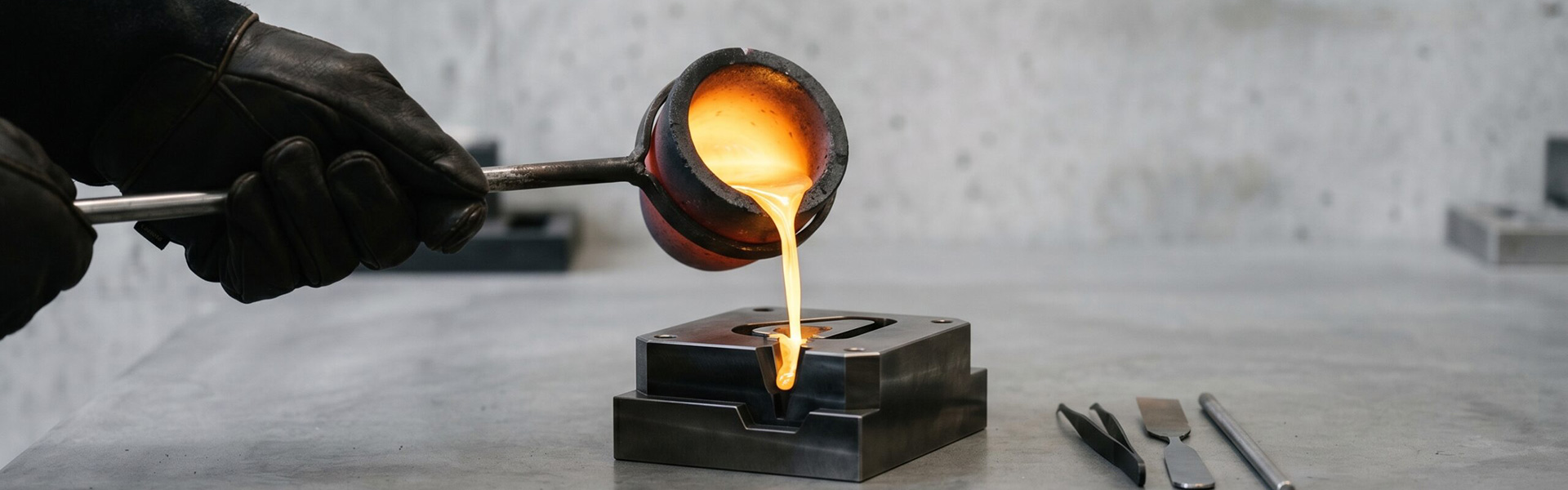
The casting moment is brief, but decisive. Molten gold must enter the mold and fill it before it begins to solidify. Depending on the technique, different methods are used to support the flow of metal, such as centrifugal or vacuum casting.
In centrifugal casting, centrifugal force helps drive the metal into the mold. In vacuum casting, the pressure difference helps evenly fill the space left by the burned-out model. The goal is always the same: a complete, clean casting, without voids, incomplete areas, or serious surface defects.
This is the stage where the jeweler’s experience is especially important. One must understand the behavior of the metal, assess the temperature, the moment of flow, the condition of the mold, and the timing. A mistake may mean having to repeat the entire process from the beginning.
Cooling, breaking the mold, and the first casting
After the gold is poured in, the mold must cool. Then the investment material is removed, and the jeweler extracts the raw casting. At this stage, the jewelry does not yet resemble the finished product seen in a display case. It is matte, covered with investment residue, with visible casting channels and excess metal.
This is a very important inspection moment. We check whether the mold filled properly, whether there are any cracks, pores, incomplete areas, distortions, or other defects. Some minor imperfections can be removed during finishing. Others may disqualify the casting.
At the Ka:ma jewelry workshop, not every casting moves forward. If the quality does not meet our expectations, we make it again. Premium jewelry requires selection and uncompromising control.
Post-casting processing: this is where precision truly begins
A raw casting requires many stages of processing. First, we remove the casting channels and excess metal. Then the surface is cleaned, evened out, ground, and prepared for further work.
This is where the difference between casting itself and jewelry craftsmanship becomes clear. The casting provides the shape, but hand finishing gives it quality. The jeweler corrects the lines, smooths transitions, refines the profile, prepares areas for stones, and checks wearing comfort.
For rings, profiling the inner part of the band is important. A wedding band or ring should not have sharp edges or uncomfortable pressure points. In the case of settings, the jeweler prepares seats for stones, prongs, rims, or channels. Every detail must be functional, not only decorative.
Stone setting after casting
If the design includes gemstones, the casting must be prepared for setting them. Stone setting is a separate, highly precise stage. The stone must be stable, well positioned, and secured, while at the same time not overwhelmed by excess metal.
Depending on the design, we use different types of settings: prong, full, bezel, pavé, channel, micro-pavé, or other solutions. Each requires a different structural preparation.
In jewelry created at Ka:ma, the stone setting should be visually light, but technically secure. Especially in engagement rings, which are worn every day, the security of the stone is crucial. A beautiful but overly delicate setting may prove insufficient in everyday use.
Polishing, matting, and final finishing
After the technical processing comes the time for surface finishing. Gold can be polished to a high shine, matted, satin-finished, sandblasted, brushed, or finished in a more decorative way.
Polishing brings out the shine of the metal, but it requires sensitivity. Overly aggressive polishing can soften edges, blur details, or alter the proportions of small elements. In our workshop, we aim for the perfect balance: the surface should be clean and luminous, but the form must not lose its sharpness or character.
Matte finishes also require precision. Satin should be even, brushing should follow the correct direction, and contrasts between shine and matte should be planned according to the design.
The final finish determines how the jewelry reflects light and how it will be perceived on the hand, neck, or ear.
Quality control: the standard of the Ka:ma jewelry workshop
At the end, every element undergoes quality control. We check the surface, symmetry, comfort, quality of setting, stability of stones, finishing of internal parts, edges, engravings, and compliance with the design.
For rings, size verification is also important. For earrings — the function of clasps. For necklaces and bracelets — the quality of connections, links, and fastenings. In jewelry with stones — the security of the setting and the positioning of the stones.
Premium does not only mean expensive material. At Ka:ma, it means control of detail at every stage. The client receives an object that has not only been designed, but also technically refined.
The most common challenges in gold casting
Gold casting requires experience because the metal is demanding and jewelry often contains small, precise elements. The most common challenges include:
Porosity, meaning tiny pores or voids in the metal. It may result from temperature problems, impurities, metal shrinkage, or improper flow.
Incomplete casting, meaning a situation in which the metal has not filled the entire mold. This may occur when the temperature is too low, elements are too thin, or channels are poorly designed.
Metal shrinkage, a natural phenomenon that occurs during cooling. The design must account for the fact that the metal may slightly change size after solidifying.
Surface contamination, which may result from an improperly burned-out mold or the presence of residue from the model material.
Deformations, especially in very thin, delicate, or asymmetrical elements.
This is why, in our workshop, we do not evaluate casting solely through the lens of technology. Even the best equipment cannot replace experience in interpreting what is happening with the metal.
Is every piece of jewelry worth casting?
Not every piece of jewelry is made by casting. Some elements are better made by hand from rolled or drawn metal, others by soldering multiple parts, and still others by combining several techniques.
At the Ka:ma jewelry workshop, the choice of method depends on the project. Casting works very well for sculptural forms, signet rings, rings with elaborate crowns, ornamental elements, and personalized designs. For simple wedding bands or minimalist forms, classic metalworking may sometimes produce a better result.
We are not attached to one method. We choose the technique according to the project, durability, and aesthetic we want to achieve.
Casting and handmade jewelry — are they contradictory?
Many clients wonder whether cast jewelry can still be considered handmade. The answer is: yes, if casting is one stage of the craft process and not mass production without individual development.
At Ka:ma, a casting may be created based on an individual design, hand sketch, 3D model, and precisely prepared mold. After casting, it requires hand finishing, stone setting, polishing, and inspection. It is not an anonymous product from a production line, but an object created through a process that combines design, technology, and craftsmanship.
Casting gives the shape. The jeweler’s hand gives it quality.
Remelting family gold
A special case in our workshop is casting jewelry from gold entrusted to us by the client, for example from wedding bands, rings, or other family keepsakes. For many clients, this solution carries enormous emotional value. Old metal can become part of a new story.
However, it is important to remember that remelting gold requires technical assessment. We check the fineness, color, alloy quality, and possible impurities. Sometimes it is necessary to add fresh metal to obtain the right quantity and properties of the alloy. Sometimes old gold is not suitable for direct use in a very precise project without prior preparation.
At the Ka:ma jewelry workshop, such a process requires special care. It is not only about the material, but also about symbolism. The client entrusts us with something that often has a value greater than the price of the gold itself.
Gold casting in personalized jewelry
Custom-made jewelry very often benefits from the possibilities of casting. Thanks to this technique, we can create a design tailored to a specific person: a ring with an unusual stone, a pendant with a personal symbol, a signet ring with an individual crest, wedding bands with an original profile, or earrings inspired by a particular form.
The personalization process begins with the design, but casting allows us to transfer that design into metal with great accuracy. This is especially important when the jewelry is to have a unique shape, a non-standard texture, or a repeated ornament.
At Ka:ma, personalization does not mean adding initials to a ready-made pattern. It means creating jewelry from scratch — from concept, through model, to finished casting and hand finishing.
Why does casting take time?
Clients sometimes ask why making custom jewelry takes longer than buying a ready-made model. The answer lies in the number of stages. We must prepare the design, model, mold, burn it out, cast the metal, clean the casting, process it, set the stones, finish the surface, and carry out quality control.
Each stage requires both technological and craft time. Some processes cannot be accelerated without risking a reduction in quality. The mold must set properly and be correctly burned out. The metal must be cast under controlled conditions. The surface must be refined by hand.
In our workshop, time is part of quality. Haste rarely serves precision.
What the client sees — and what they do not see
The client sees the final shine, the color of the gold, the stone, and the beautiful proportions. However, they do not see most of the decisions that led to this effect: choosing the alloy, adjusting the design, planning the casting channels, controlling the temperature, removing excess metal, micro-grinding, checking the setting, and the successive stages of polishing.
It is precisely these invisible elements of work that create the difference between an average product and premium jewelry. A well-made casting should not draw attention to itself as “cast.” It should simply look natural, harmonious, and noble.
Casting as a combination of technology and craftsmanship
Gold casting shows what contemporary jewelry-making is: a combination of ancient technique, modern tools, and manual work. The lost-wax method has a very long history, but today it can coexist with 3D design, model printing, vacuum casting, and precise quality control.
Experience, however, remains the most important factor. It allows us to decide whether a design requires modification, whether the mold is correct, whether the casting is good enough, and how to bring raw metal to its final elegance.
At the Ka:ma jewelry workshop, gold is not just a material. It is a medium that requires respect, patience, and technical awareness.
Summary: from molten metal to an object with a story
Gold casting is the process in which a design becomes reality. It begins with a concept, model, and mold, passes through metal melting and the casting moment itself, and ends only after many stages of hand processing, setting, and finishing.
At the Ka:ma jewelry workshop, each of these steps matters. What counts is not only that the jewelry is made of gold, but how that gold has been prepared, cast, worked, and refined. A good casting is the foundation, but only the combination of technology with the jeweler’s hand creates an object that can be worn for years, passed on, and treated as a personal story enclosed in precious metal.