

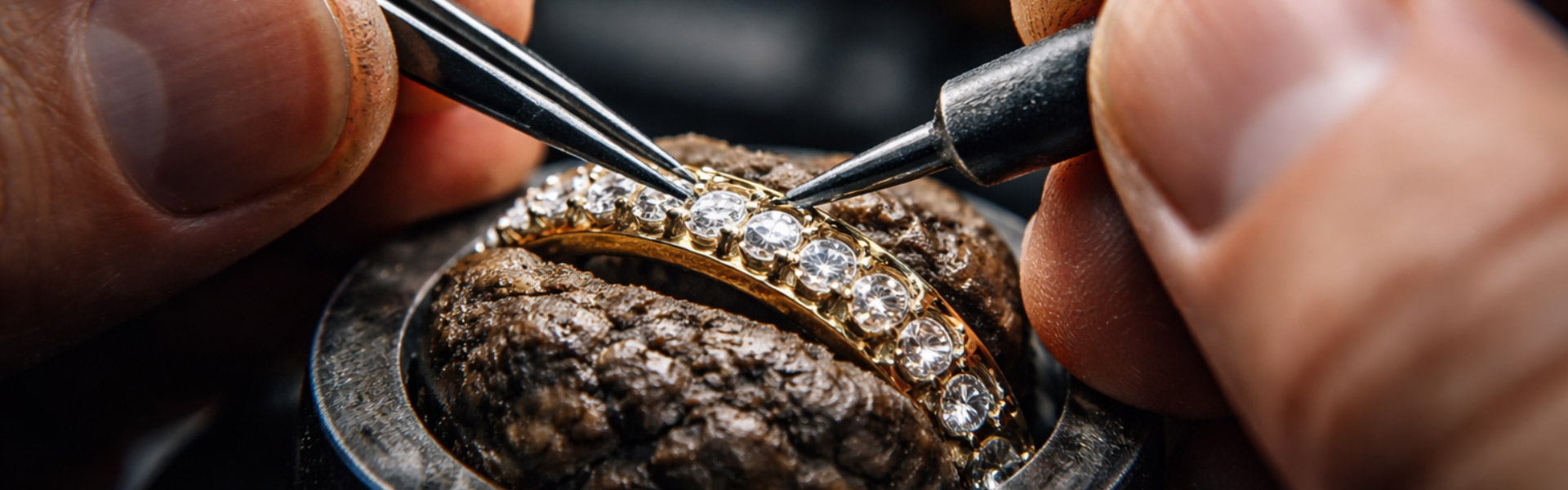
Microscope Diamond Setting – Precision Beyond the Human Eye
In the world of premium jewelry, perfection is not a slogan—it is the result of dozens of micro-decisions, hundreds of tool movements, and multi-stage quality control, all leading to one final effect: breathtaking precision that feels almost impossible to attribute to the human hand.
One of the most important craftsmanship technologies that makes this level possible is diamond setting under a microscope. This method allows our goldsmiths to perform the key stages of stone setting under high magnification—not to make the process “more complicated,” but to execute it exactly as top-tier jewelry demands.
Why Does a Microscope Change the Standard of Setting?
A diamond’s hardness is impressive, but setting is not a battle against the material. Setting is the art of shaping metal (prongs, bezels, micro-prongs) so that:
- the stone is stable and secure,
- the metal does not exert risky pressure on the diamond,
- light can work freely (so the diamond sparkles and “breathes”),
- the finish is flawless—slim, clean, without burrs, edge waviness, micro-scratches, or metal drag marks.
Under a microscope, we see details that even the best lighting and magnifying loupe cannot reveal: microscopic irregularities in the seat, minute asymmetries in prongs, micro-damage to the metal, or unwanted internal stresses. In premium jewelry, these details determine whether a setting is merely “good” or truly uncompromising.
What Exactly Does Microscope Diamond Setting Achieve?
1) Perfect Geometry and Symmetry
In premium settings, symmetry is not an aesthetic whim—it is a prerequisite for optical harmony. If prongs are even slightly uneven, the stone appears visually misaligned and light dispersion becomes less balanced. A microscope allows precise control over:
- identical height and width of prongs,
- equal distances between pressure points,
- perfect axial alignment of the stone within the design.
2) Minimal Metal, Maximum Security
In high-end jewelry, the goal is for the metal never to overpower the stone. Microscope work enables setting “at the edge of visibility”:
- prongs can be slimmer yet fully secure,
- bezels or channel edges can be thinner and more elegant,
- micro-prongs in pavé settings can be delicate and perfectly even.
The result? The diamond appears larger and brighter, while the composition feels lighter and more refined.
3) Superior Protection of the Diamond’s Edges
The most sensitive parts of a diamond include the girdle and edge areas. Poorly prepared seats or uneven prong pressure can lead to micro-chipping. Microscope setting allows us to:
- precisely match the seat to the girdle profile,
- distribute pressure evenly,
- avoid point stress in critical areas.
4) Haute Joaillerie–Level Finishing
In premium jewelry, there is no room for “almost invisible” imperfections. A microscope makes it possible to:
- perfectly smooth and polish surfaces directly next to the stone,
- remove micro-burrs that could catch on fabric,
- achieve crisp edges and mirror polish without the risk of touching the diamond with tools.
Microscope Diamond Setting – Step by Step
While each project has its nuances, in premium jewelry the process typically includes:
- Stone verification – checking proportions, girdle thickness, and any inclusions near edges (crucial for planning the setting).
- Seat preparation – micro burs and cutting tools create a seat with hairline precision (or rather: a fraction of a hair).
- Dry fitting – the stone is placed without pressure to check alignment and height.
- Setting and securing – prongs or bezels are formed using controlled movements with evenly distributed force.
- Prong tip shaping – the prong finish is the atelier’s signature: classic, claw, pear-shaped, bead, etc.
- Finishing and polishing – removing micro-scratches, refining transitions, achieving final brilliance.
- Quality control – stone stability, prong symmetry, wearing comfort, and aesthetics under magnification.
This final step is crucial: premium jewelry must withstand inspection under magnification. If a setting looks perfect at 20–40× magnification, it will look like a true work of art in everyday wear.
Which Settings Benefit Most from Microscope Work?
1) Pavé and Micro-Pavé
Dozens or even hundreds of small diamonds, each set individually. A microscope ensures:
- an even line of stones,
- identical micro-prongs,
- a clean surface without “flooded” metal.
2) Channel Setting
Here, perfectly even “rails” and controlled pressure on the girdle are essential. A microscope enables precise fitting and a uniform line of light.
3) Prong Setting
In engagement rings and solitaires, a microscope helps with:
- perfect axial alignment of the stone,
- refined prong aesthetics,
- minimizing metal without compromising security.
4) Bezel Setting
The bezel must “embrace” the stone evenly and elegantly, without waviness. Under a microscope, it is possible to achieve a thin, perfectly smooth bezel—highly desired in modern premium jewelry.
Microscope Work and Durability: Does It Really Matter?
Absolutely—because most setting issues begin with tiny details:
- a seat that is just slightly too shallow,
- an uneven prong that “moves” over time,
- a micro-burr that catches and gradually bends the metal,
- a suboptimal pressure point near the diamond’s edge.
Microscope setting allows these risks to be identified and eliminated before the jewelry leaves the atelier. That is the difference between a “pretty ring” and an object meant to remain beautiful after years of wear.
What Should a Client Know When Choosing a Premium Setting?
If you are buying diamond jewelry—especially in the premium segment—it is worth paying attention to a few things:
- Does the atelier explicitly state that diamonds are set under a microscope (not just “inspected”)?
- What is the symmetry of the prongs and the cleanliness of the finish next to the stone?
- Is the setting visually light, yet structurally secure?
- Does the piece undergo quality control under magnification?
These are the questions that distinguish a craftsmanship-driven brand from a brand built mainly on design.
Summary: Luxury Begins at the Microscale
Diamond setting under a microscope is not a “gadget” or marketing. It is a tool that allows us to deliver what the premium market expects: perfect geometry, clean lines, maximum brilliance, and true stone security. The best setting is the one you do not notice – because all you see is the diamond and its light. A microscope helps ensure that this “invisible perfection” becomes the standard in premium jewelry.