

Casting or Handcrafting? How Premium Custom Jewelry Is Really Made
When it comes to premium custom-made jewelry, one question comes up very often: is it cast or handmade? However, this question is not entirely well-posed, because in high-end jewelry making, casting and handcrafting do not exclude each other. On the contrary—top-tier ateliers combine modern technology with master-level hand finishing to achieve exactly what premium clients expect: perfect form, flawless details, wearing comfort, and durability for years to come.
Below, we present this topic in more detail from our perspective.
What Does Cast Jewelry Mean?
Cast jewelry is jewelry whose base structure (ring shank, stone setting basket, decorative elements) is created by pouring molten metal into a previously prepared mold. Most commonly, the lost-wax method (investment casting) is used, as it allows the model’s shape to be transferred very accurately into gold or platinum.
Below is how this process looks in practice.
First, we create a wax model and/or a 3D-printed model – in the premium segment, this stage is crucial, because it is where proportions are defined (slimness, height, width), ergonomics (how the ring sits on the finger), and stone construction (placement of prongs, rims, channels). We then prepare the mold and burn out the model – this is the stage where technology determines quality: temperature, timing, compound parameters, and process cleanliness all influence whether the casting will be clean and structurally sound. Next, we pour the precious metal alloy into the mold – in the premium segment, alloy quality and process control are equally critical (purity, consistency, and minimizing porosity).
Finally, we carry out post-casting work – removing sprues, initial grinding, and corrections. In premium jewelry, one thing is essential: casting is only a semi-finished product. A “straight-from-the-cast” piece is never luxury. Luxury begins where the casting passes into the hands of our master craftsman.
The Advantages of Casting in Custom Jewelry
In premium custom jewelry, casting is often the best starting point—not because it simplifies the work, but because it provides a structural base with a level of precision that is difficult to achieve purely by hand. Especially in designs requiring perfect symmetry, repeatability, and complex geometry, a well-executed casting allows the original design assumptions to be preserved down to tenths of a millimeter.
The key advantages of casting include:
- repeatable geometry (important for wedding bands, complex stone baskets, and symmetrical elements),
- the ability to create complex forms that are extremely difficult to achieve cleanly and evenly by hand,
- better control over fit to the design (e.g. matching a wedding band with an engagement ring as a set).
Limitations of Casting
Casting may involve micro-porosity, minor structural imperfections, surface texture, and less-defined sharp edges. That is why premium jewelry requires:
- manual surface refinement,
- structural corrections,
- precise adjustment of proportions for stone setting,
- final polishing that does not hide flaws, but reveals quality.
In custom-made projects, casting is a tool which—when used by an experienced atelier—ensures a perfect and repeatable form. However, the final character of premium jewelry is always defined by hand refinement, finishing, and stone setting.
What Does “Handmade” Mean?
Handmade jewelry is a broad term, and that is precisely why it deserves clarification. For some, it means jewelry “made without casting,” for others “without CAD.” For premium ateliers, it usually means something more: that the key stages determining quality are performed by the hand of a master craftsman, with full control over detail, structure, and finish.
In practice, handcrafting may involve three main areas.
1) Building the Entire Form from Scratch
This is classic goldsmithing: the jewelry is created from sheet metal, wire, or profiles, and the form is built through:
- sawing and fitting individual elements,
- turning and shaping profiles,
- rolling, bending, and hammering,
- soldering and joining structural components,
- manual shaping of volume and proportions.
This method offers enormous creative freedom and direct influence over the final form, but it also requires very high-level skills—because every millimeter is the result of a conscious decision and a precise hand movement.
2) Hand-Built Settings and Baskets (the Heart of the Ring)
In jewelry featuring a central stone, especially in the high-end segment, this is often the most critical area of manual craftsmanship. The goldsmith hand-builds or hand-refines:
- prongs (their thickness, shape, symmetry, and line),
- crowns and galleries (the “architecture” beneath the stone),
- seats for the girdle and stone bearing surfaces,
- structural elements responsible for the durability and security of the setting.
In premium jewelry, the qualitative difference usually does not lie in whether the ring shank was cast, but in how the setting was made—whether it is delicate, even, stable, and beautiful even under magnification.
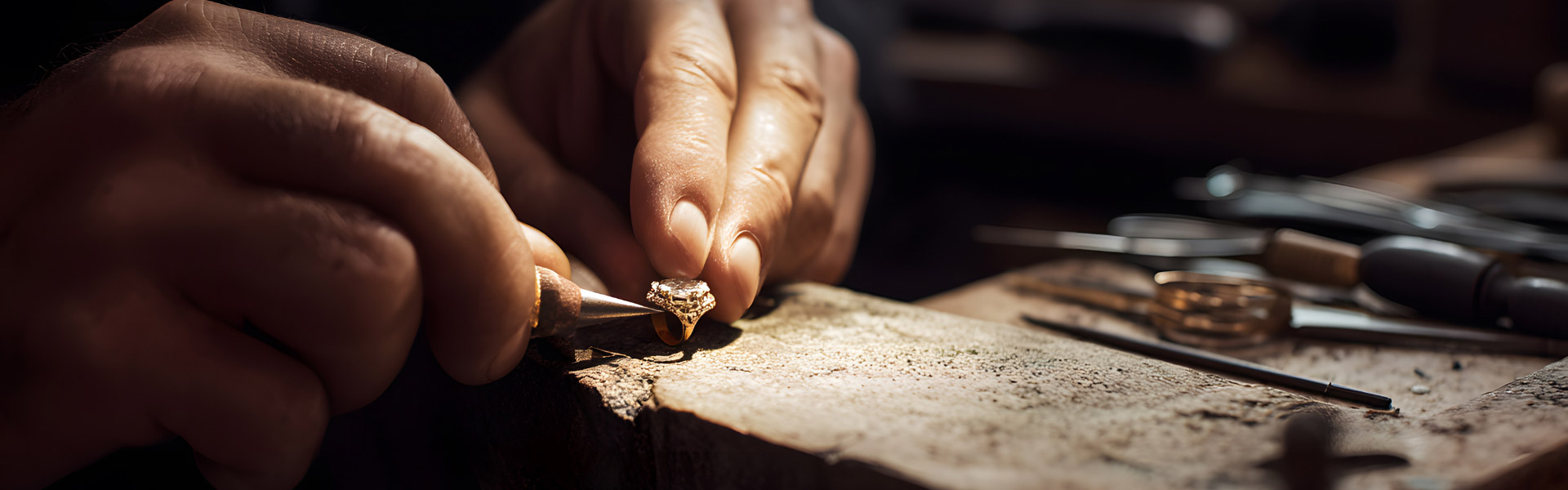
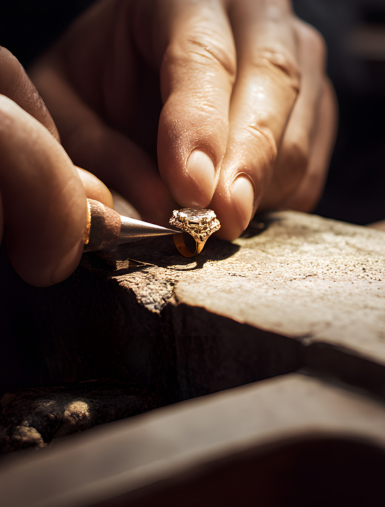
3) Hand Finishing – the Stage That Defines “Premium”
This is the moment when jewelry stops being merely a form and becomes a luxury object. Hand finishing includes, among others:
- precise grinding and leveling of surfaces,
- cutting chamfers (controlled, elegant transitions along edges),
- refining edges for wearing comfort (so the jewelry does not catch and feels pleasant on the skin),
- mirror polishing without surface waviness,
- meticulous refinement around stones, where micro-scratches and imperfections are most likely to occur.
That is why, in the premium segment, the term “handmade” most often means: key elements are made and finished by hand—even if the structural base was created using modern technology.
The Advantages of Handcraft in Premium Jewelry
The greatest value of handcraft lies in the combination of precision and flexibility: perfect detail in critical areas, jewelry adapted to an individual hand, and a setting “tailored” to a real stone rather than an idealized model.
The key advantages of handwork include:
- maximum control over detail – the master’s hand maintains control where technology can be too binary, especially in critical areas such as edges, prongs, and the contact between metal and stone;
- custom fit for the client – handwork allows precise adjustment of stone height above the finger, band profile and thickness, and edge ergonomics;
- flexibility with natural stones – diamonds and gemstones, even with identical weight and cut, can differ slightly in proportions, girdle thickness, and symmetry; handcraft allows the setting to be adapted to the actual stone.
In premium jewelry, handwork is the tool that refines what cannot be fully programmed or automated. Where microns, ergonomics, and the individual character of a stone matter, the master’s hand remains irreplaceable.
Limitations of Purely Handcrafted Work
There are designs in which purely manual work is challenging not because of skill level, but because of geometry. In highly complex, symmetrical constructions, it is more difficult to achieve:
- absolute, mathematical symmetry (e.g. in openwork designs),
- perfect repeatability of details (e.g. multiple identical segments),
- dimensional control in microscopic multi-stone settings (pavé, micro-pavé), where tolerances are extremely small.
In projects based on complex geometry and perfect symmetry, handwork alone may make it harder to maintain repeatability and mathematical precision. That is why, in openwork constructions and microscopic multi-stone settings, we most often use technology to control dimensions—leaving the master’s hand for refining details and final finishing.
The Hybrid Approach Is the Premium Standard
In the highest tier of custom-made jewelry, the hybrid model most often prevails: technology for structure and geometry, combined with handcraft for settings, adjustments, and finishing. This approach delivers both the precision expected by premium clients and the mastery provided by the hand of an experienced goldsmith.
In other words, technology creates the perfect form, while the goldsmith’s hand gives it class, character, and the highest level of craftsmanship. This ensures that the design remains faithful to the intended dimensions and proportions, while preserving what truly distinguishes premium craftsmanship from mass production.
This synergy is, today, the most honest definition of premium jewelry.
Summary
Casting and handcrafting in premium jewelry do not exclude one another—they are two tools that, in the finest creations, work together. Casting and technological design provide control over geometry and repeatability, while the goldsmith’s hand determines what truly matters and what can be seen and felt: the quality of the setting, the finish, ergonomics, and the refinement of detail.
That is why, in premium custom jewelry, the most important question is not “cast or handmade?” but rather: which stages of the process are performed by hand, to what standard, and how quality control is carried out during stone setting and finishing.
In this regard, you can rely fully on our quality and experience.